
Lesson 1: Prefer Active Voice
Introduction to Passive and Active
The following sentence is written in active voice: Bob surfs the Internet.
Here’s that sentence cast in passive voice: The Internet is surfed by Bob.
In English grammar, voice is a quality of verbs that lets you know whether the word or phrase falling immediately before a verb construction is a true subject (actor) or really an object (something acted upon). If the verb is expressed in active voice—like “surfs” in the first example sentence above—then the noun (“Bob”) falling before the verb is the agent carrying out that verb action.
But if we express the verb in passive voice (“is surfed”), the noun or noun phrase (“The Internet”) falling before the verb is not the true agent carrying out the verb action, even though it has appropriated the sentence’s “subject slot” and will be called the subject by some grammar handbooks. In reality, it remains the recipient, or object, of the verb’s action.
We use the term passive to describe the verb construction that achieves this flip-flop of subject and object because it causes the true, active agent (the subject) of the sentence to take, as it were, a passive role, placing itself out at the end of the sentence where it looks, if you’re not alert, like the passive recipient of action—simply because it occupies the object slot in the sentence.
A Word about Voice
Let’s step back for a brief grammar lesson that will put into perspective the concept of grammatical voice.
Every verb you see in an English sentence carries with it five grammatical attributes:
- Person
- Number
- Tense
- Mood
- Voice
Consider again: Bob surfs the Internet. The verb, surfs, is in:
- Third person
- Singular (Number)
- Present tense
- Indicative mood
- Active voice
English verbs can be expressed in two different voices: Active and Passive. The active voice shows up in the subject-verb-object pattern you’ve been familiar with all your life, if you’re a native speaker of English.
Consider once again: Bob surfs the Internet. This is the simplest, most direct pattern for English sentences.

When a transitive verb—that is, a word transmitting action or influence—is in its active voice form, that means it’s doing its usual job of funneling some action from the actor (subject) to the thing acted upon (the object of the verb).
Passive voice is a bit more complex. To express our sentence “Bob surfs the Internet” in passive voice, we must recast the verb into its past participial form (surfed), preface it with a form of the verb “to be” in the appropriate number and tense (in this case “is,” because the verb in our model sentence is singular, present tense), and we must flip-flop the order of subject and object. That is, subject and object trade places in our passive-voice sentence. What’s more, we must preface the subject with the word “by,” just so we don’t get confused. Whew! What a lot of work.
When we do all this, we end up with a longer sentence:
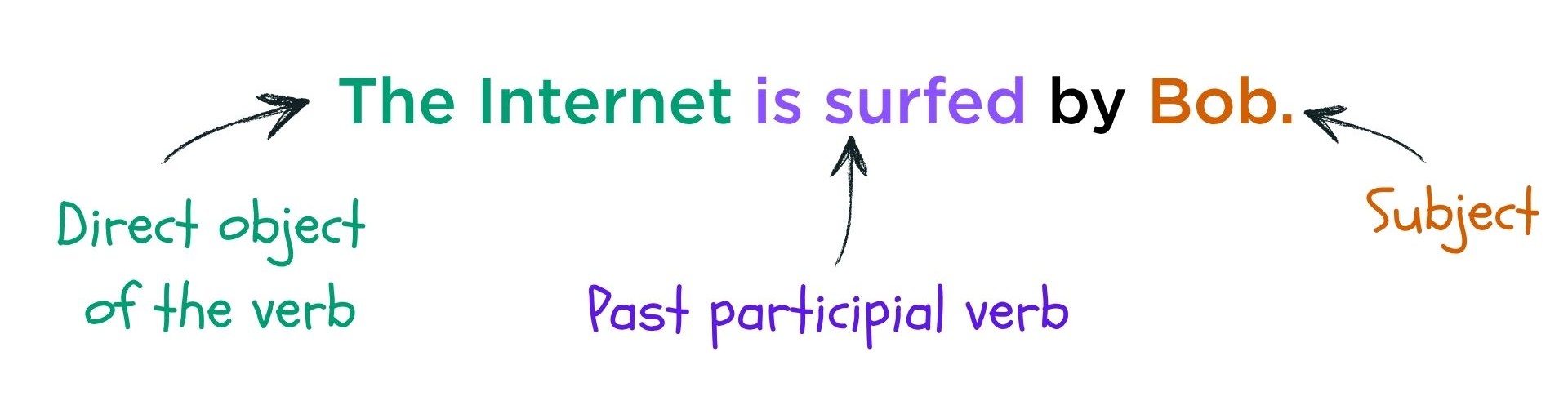
Once again, the passive voice uses an auxiliary verb (any form of the verb “to be”) placed before the past participle of the main verb:
| Form of “to be” | Past participle |
|---|---|
| is | seen |
| were | checked |
| was | made |
| will be | computed |
Active versus Passive Examples
Here are more sentences, expressed first in active voice, then in passive:
- Active: We checked the printouts.
Passive: The printouts were checked by us. - Active: The managers see the problem.
Passive: The problem is seen by the managers. - Active: He bought a stock.
Passive: A stock was bought by him. - Active: The engineers will compute the tolerances.
Passive: The tolerances will be computed by the engineers.
Of course, it’s also possible to form passive constructions that omit the subject entirely. Just leave off the “by” phrase from the sentences 1-4 above:
- The printouts were checked.
- A problem is seen.
- A stock was bought.
- The tolerances will be computed.
Why Passive Can Be a Problem
This leaves it to the reader to figure out who checked the printouts, who sees a problem, who bought a stock, who will compute the tolerances.
Passive voice makes us “think backwards,” and it often leaves us wondering who is responsible for things (since it often omits the subject). It takes the zip out of sentences. When a passive construction does include the subject, we see that the sentence is considerably longer than it could be in active voice—and it still didn’t get its zip back.
Why then do so many people overuse passive voice? For many reasons:
- They are trying to avoid using personal pronouns (“I,” “We,”, etc.)
- They have seen a lifetime of poor models.
- They have become convinced that passive constructions sound more dignified, scientific, or “professional.”
- They are trying to hide responsibility (by not identifying agents).
- They are lazy (they don’t want to exert themselves to discover the agents of actions).
- Their minds land on actions or objects first, and they don’t make the effort to flip their sentences around into active voice order.
Common journalistic style has also led people astray:
- The president’s immorality is deplored by the entire nation
- The official story has been rejected by local citizens.
- The dying woman was abandoned by the senator from Massachusetts.
The Advantages of Active Voice
But one can read the sentences more quickly and easily in the active form:
- The entire nation deplores the president’s immorality.
- Local citizens have rejected the official story.
- The senator from Massachusetts abandoned the dying woman.
Note again: the active versions are all shorter than their passive originals. But we read them more quickly not simply because they are shorter, but because our brains integrate the information more readily in the actor/action/object format (cause and effect relationship). This is the order we learned in our youth, and we still do better with this structure than with the passive construction. (I never say to my children, “Your feet must now be wiped by you.” I generally shout, “Wipe your feet!” (understood “you” or “y’all”).
Consider the following nursery rhymes and note how much more communicative they are in the active voice:
There was an old woman who lived in a shoe. She had so many children, she didn’t know what to do. She gave them some broth, without any bread, spanked them all soundly, and sent them to bed.
Now listen to it in passive voice:
A shoe was lived in by an old woman there was. What to do was not known, so many children were had by her. Some broth without bread was given to them, They were all spanked soundly and sent to their beds by her.
Maybe her kids were using too much passive voice, and she got upset with them.
Practice, Lesson 1: Prefer Active Voice

Enter your revision in the box below each exercise. Click the “>” below each box to see Dr. Hirst’s revision.
Exercise 1: Active to Passive
Try your hand at ruining a nursery rhyme by couching it in all passive voice:
Eencey Weencey spider
Climbed up the water spout;
Down came the rain
And washed poor Eencey out;
Out came the sun
And dried up all the rain;
And the Eencey Weencey spider
Climbed up the spout again.
> Open to see Dr. Hirst’s sample response:
The water spout was climbed up
By Eency Weency spider;
Poor Eency was washed out
By the rain that came down.
All the rain was dried up
By the sun that came up
And the spout was again climbed
By the Eencey Weencey spider.
Hard to work against the grain, isn’t it? The passive voice version is longer, harder to read, and less effective. So stop doing this to your own sentences! Let active voice be your “default” voice. Your prose will be crisper, more pleasant, and more effective.
Exercise 2: Passive to Active
Change all passive constructions to active constructions in the following sentences.
Hint: Don’t be afraid to invent an appropriate subject (i.e., agent, person, or organization) where one or more is lacking.
1. The new chips were sold by the company.
> Open to see Dr. Hirst’s sample response.
The company sold the new chips.
2. The formula was prepared.
> Open to see Dr. Hirst’s sample response.
Nutritionists prepared the formula.
3. If the offer is accepted, make sure that the proper form is completed and signed.
> Open to see Dr. Hirst’s sample response.
If the customer accepts the offer, make sure that he or she completes and signs the proper form.
4. Software has been provided by Apple Computer for the lab’s current needs as requested.
> Open to see Dr. Hirst’s sample response.
As the Engineering Department requested, Apple Computer has provided software for the lab’s current needs.
5. Since only the printer can be considered to be on sale, the computer discount cannot be applied.
> Open to see Dr. Hirst’s sample response.
Since management considers only the printer to be on sale, we cannot apply the computer discount.
6. This drug has been assigned a maximum dosage of 5 milligrams.
> Open to see Dr. Hirst’s sample response.
FDA officials have assigned this drug a maximum dosage of 5 milligrams.
7. Standards have been raised and should be discussed with the client, unless these changes are already known.
> Open to see Dr. Hirst’s sample response.
ABB Enterprises has raised its standards; you should discuss these changes with the client unless he or she already knows about them.
8. The test results have been analyzed and a decision has been made to request further testing on site.
> Open to see Dr. Hirst’s sample response.
Our decontamination engineers have analyzed the test results, and they have decided to request further testing on site.
9. The following guidelines must be observed when documentation packages are being developed.
> Open to see Dr. Hirst’s sample response.
Technical writers must observe the following guidelines when developing documentation packages.
10. A device-checking circuit is being written into machine control logic because complaints have been made about the difficulty of checking on machine operation.
> Open to see Dr. Hirst’s sample response.
ACME engineers are writing a device-checking circuit into our machine control logic because customers have complained about the difficulty of checking on machine operation.
Exercise 3: Final Challenge
Edit the following paragraph. Change all passive constructions to active:
When your diagrams have been approved, one copy of each diagram will be returned to you. Equipment must also be approved by ACME engineers. All Hydraulic components must be indicated on the diagram, and the function of all components must be explained. It is important that circuitry drawings, also, be made to conform to ACME standards. These are to be drawn to match the cycle starting point of electrical drawings.
> Open to see Dr. Hirst’s sample response.
When ACME engineers have approved your diagrams, we will return to you one copy of each diagram. Our engineers must also approve your equipment. Please indicate all hydraulic components on your diagrams and explain the function of all components. You must also conform your circuitry drawings to ACME standards, drawing them to match the cycle starting point of your electrical drawings.
Return to the Professional Writing Style: 12 Tutorials main page