
Lesson 10: Conquer Punctuation
Punctuation’s Role
Punctuation is a system of speech notation marks. To “punctuate” in this system literally means to make little pointy marks interspersed among written words. This markup helps us properly “perform” (and thus hear) in our heads various sound qualities of the sentences we read. It also helps us perform those sentences aloud, when we speak those written words to others.
Yes, punctuation can also signal or help signal various grammatical distinctions, but its main function is, I assert, speech notation. Punctuation is to a reader or speaker of words what musical notation is to a musician. Well ok, it’s not nearly so complete as musical notation, not in the minimalist form we have it in our post-elocutionary world. But it’s what we have, and it’s super important, so let’s master it.
So again, I’m saying we “perform” our words. The combined action of the human tongue, lips, jaw, throat, lungs, etc. constitutes an instrument that performs speech. We can also perform speech in an overtly musical way; we call this song. We can also perform music by blowing through musical instruments, such as flutes and horns. In those cases, our fingers help the performance.
Types of Notation
Humans have many modes of performance, and for most of them we use systems of notation to help others (and ourselves) perform what we have in mind. For example, we use musical notation (written notes and various symbols, letters, and lines) to help orchestras perform our symphonies. We create what we call musical scores, and we read those scores to perform the music. They tell us not just what notes to play but also timing, volume, phrasing, and much more. Another example of performance markup would be dance notation (there are various systems)— little stick figures, geometric symbols, shading, dots, direction arrows, diagrams, etc. And of course dance notation is often merged with some forms of musical notation, because dance is usually coordinated with music.
For human speech performance, what we used to call elocution, there is a long history of notational systems. For an example, check out the system of John Walker (18th-century British actor, author of Elements of Elocution). Many of these notation systems differ from each other, and many use hundreds or thousands of marks/symbols to guide speech performance. If you have ever taken a speech class or an acting class, you know what I’m talking about. And that’s just for speaking; we’re not even getting into “actio” (action), directions for gestures and other body movements while speaking.
Punctuation is Print Notation
Punctuation has been called, aptly, the “print code.” Punctuation helps us signal in print the kinds of things we signal, when speaking, with voice patterns, intonation, volume changes, pauses, pitch changes, facial expressions, and yes even body movements. Unless we master the print code, our writing is severely impoverished—just as our speech would be impoverished if we couldn’t vary our vocal patterns or facial expressions or body movements.
I acknowledge that we also use variations of type style to indicate levels of stress/emphasis we wish readers/speakers to apply. I mean our (excessive) use of capital letters, italics, underlining, boldface, or varying font sizes, shapes, or styles. We use these things to signal, in print, some of the things traditionally signaled by punctuation. This has become more common as personal computers, with their many visual options, have flooded the world. The line between text and image has never been a sharp one, and computers have blurred it even further. One of the most amusing examples of this is images made of type—mostly punctuation marks!—used in millions of email messages.
But I am excluding such typographical variations here in our discussion of the traditional print code, punctuation. Punctuation is, as I’ve explained, a specific “point-marking” notational system we have used for centuries to guide performance of human speech. It shows the parts and edges of sentences, and sometimes the relationship of the parts; that is its grammatical function. But punctuation also creates or reinforces psychological aspects of our sentences. That is its stylistic function, and style is my theme in these 12 lessons.
Punctuation Types
Let’s now look at some of the most important, and most troublesome, aspects of the print code. In this lesson, you’ll improve your mastery of the following kinds of punctuation:
Commas
The trickiest, and probably the most important piece of punctuation, is the comma. That’s because, of all the punctuation marks, it’s the one most used not just to help signal grammatical features of sentences, but to help create rhythm and style. Sometimes you must use a comma or you’ll drastically mislead your readers, perhaps even shock them:
Let’s eat, Grandpa.
vs.
Let’s eat Grandpa.
Sometimes a comma isn’t necessary, but it’s helpful. In other instances, you’ll want to take “poetic license,” inserting or omitting a comma to achieve some desired effect. But remember: you can’t break rules intelligently until you master them.
Let’s review how to use commas correctly and how some people (not you) use them incorrectly. I’m going to blast through a long list of traditional rules, so hold on.
Use commas to:
1. Introduce words and phrases
Unfortunately, the experiment failed.
After a long period in the red, ACME emerged into the black.
2. Join compound sentences
Both occupants of the car were wearing seat belts, so injuries were minimal.
They finished writing the proposal, and that was all they could manage before collapsing.
Bruno bench pressed 500 pounds, yet he himself weighed a mere 395.
3. Set off nonrestrictive elements, including appositives
Galapagos tortoises live to be about 200, which is an impressive life span.
The Whisper 2000, a rotary engine, is quiet and economical.
4. Set off interjected and transitional elements
The president of the United States is elected, believe it or not, via the electoral college.
Weld power wiring, therefore, requires more than a 2″ conduit.
5. Separate items in a series
We bought nuts, bolts, wires, tape, and bandages.
Radionuclides have hurt our herons, mutilated our minks, wounded our walleyes, traumatized our trout, and brutalized our beavers.
Note: It’s an excellent idea to include that final comma just before the “and.” Many people leave it out, sometimes creating an ambiguity, as in “He took courses in math, science, economics and architecture of Medieval Europe.” This leaves the reader wondering whether “economics and architecture of Medieval Europe” is one course or two.
6. Set off direct address and “tag questions”
Look into your hearts, members of the jury, and find compassion there.
Detaching the blue wire disarms the bomb, doesn’t it?
7. Set off quotations
As the saying goes, “Old fishermen never die; they just smell that way.”
[But don’t use a comma if your sentence introduces the quotation with “that,” or if your quotation is indirect or just part of a longer construction]:
The adage says that “old fishermen never die; they just smell that way.”
People who ask “How are you?” really just mean “Hello.”
8. Set off dates, addresses, and titles
The product must ship by June 12, 2001.
Seattle, Washington is called the Emerald City.
Rebecca Davis, M.D., performed the surgery.
9. Avoid confusion and awkward-looking prose
The members of the committee walked in, in time to vote.
not:
The members of the committee walked in in time to vote.
Before, they had believed the containers to be full of harmless sludge.
not:
Before they had believed the containers to be full of harmless sludge.
FYI, don’t use commas:
1. To introduce or finish a series
Wrong: We ordered a mix, of soybeans, corn, wheat, and rice.
Right: We ordered a mix of soybeans, corn, wheat, and rice.
Wrong: I’ve always wanted a big, expensive, loaded, computer.
Right: I’ve always wanted a big, expensive, loaded computer.
2. In compound constructions
Wrong: Safe drinking water, and clean air are essential to health.
Right: Safe drinking water and clean air are essential to health.
Wrong: The field is infested with grasshoppers, and Japanese beetles.
Right: The field is infested with grasshoppers and Japanese beetles.
3. Around restrictive elements
Wrong: This is the switch, that starts the engine.
Right: This is the switch that starts the engine.
4. Between subjects and verbs, verbs and objects (or compliments), prepositions and verbs
Wrong: The mercury model, considers both organic and inorganic mercury.
Wrong: The mercury model considers, both organic and inorganic mercury.
Wrong: The fish ate, about a barrel of feed per day.
5. Between independent clauses
Data gathering has always been a primary component of regulatory programs, it is a given that we will ask corporations and businesses for data.
Note: placing commas between independent clauses (full sentences) produces the infamous comma splice. An easy fix is to change the comma to a semicolon or link the two sentences with a coordinating conjunction (and, or, for, but, so, yet). Or you can just end one sentence with a period and start a new sentence. But don’t choose one of these options arbitrarily. Choose according to your rhetorical purpose. If, for example, you wish to reinforce a cause-effect relationship between two sentences, you may want to join them with a semicolon rather than chopping them into two distinct sentences. More on this shortly.
Using Commas Rhetorically
Choosing punctuation according to rhetorical purpose means you punctuate in order to achieve some psychological effect. For example: a sentence reads faster with minimal punctuation. Punctuation-laden sentences read more slowly. Sometimes, you’ll want to speed up or slow down your reader. If you want to convey a sense of urgency or speed or rushed confusion, you can intensify this effect via punctuation (or lack thereof):
The investors want to see our phone transcripts and email and memos and maps and sketches and figures and projections before they’ll even begin to consider our proposal.
BTW, you may feel tempted to italicize, underline, or boldface “begin.” Resist. Trust your reader. You’ve already set up the sentence in such a way that emphasis must (must) fall on that word.
Now let’s try slowing down a sentence:
Vehicle congestion is terrible, particularly in communities like this, where urban sprawl, unplanned, and the need to commute, unavoidable, combine, every weekday morning, to produce sluggish caravans of coughing, creeping autos.
Did you feel yourself sputtering and creeping along in that sentence, like those poor autos? Good. That’s what I intended you to feel.
Normally, however, you won’t want to slow down your reader that much. But you will certainly want her to pause or mentally “breathe” at chosen spots in your sentence. It’s best to “feel” those spots yourself, as you’re writing, and insert the commas as you go, rather than backtracking to pepper them in later. Take the advice of scientist-writer Lewis Thomas:
The commas are the most useful and usable of all the stops. It is highly important to put them in place as you go along. If you try to come back after doing a paragraph and stick them in the various spots that tempt you you will discover that they tend to swarm like minnows into all sorts of crevices whose existence you hadn’t realized and before you know it the whole long sentence becomes immobilized and lashed up squirming in commas. Better to use them sparingly, and with affection, precisely when the need for each one arises, nicely, by itself.
- Since this section is long, we’ve provided a link to the practice section for commas
Colons
Use colons to
1. Introduce a list:
We need just three things from you: cooperation, trust, and money.
2. Introduce reasons:
The Oak Ridge Reservation is clearly an excellent choice for consolidation of the nation’s plutonium production: it has an experienced national lab, a very secure facility, an abundant supply of water, and a supportive local community.
If you want to end the sentence with the line naming the Oak Ridge Reservation, for the rhetorical punch gained, you can recast the sentence to make the support (the reasons) precede the claim. You’ll still want a colon:
To consolidate the nation’s plutonium production at one site, we need an experienced national lab, a very secure facility, an abundant supply of water, and a supportive local community: the Oak Ridge Reservation is clearly an excellent choice.
3. Introduce illustrations:
Asthmatic patients can react to any kind of mammal dander: rabbits, for example, can be just as troublesome as cats.
4. Set off headers and notices of various kinds:
Note: pay close attention to details.
Warning: inattention to punctuation can ruin your style.Remember: a colon says “namely,” “the following illustrates my point,” “for example,” “as follows,” or “note this.”
Semicolons
Use semicolons to
1. Link two closely related sentences (especially sentences in cause-effect relationship):
Mercury levels in streams are alarmingly high; swift remedial action is needed.
The new digital cameras are the size of a credit card; wallets will soon bulge with them.
The company offered its stock at half price; consumers swarmed to buy it up.
2. Divide a single, long, main clause into readable chunks:
We took photos in the misty byways of London, the seamy underbelly of Paris, and the hot backstreets of Madrid; in the sprawling slums of Buenos Aires, the shivering outskirts of Lima, and the crowded streets of Mexico City; in the waterways of Hong Kong, the gardens of Kyoto, and the mud-bogged streets of Manila.
3. Divide a long sentence made up of multiple independent clauses:
Some species of animals, such as mink and otter, rank high on the scale of social value; other species, such as raccoon and beaver, fall somewhere around the middle of that scale; still other species, such as carp and skunk, nearly fall off the bottom of the scale.
When you have a string of independent clauses like this, it’s always possible simply to come to a full stop (period) at the end of each clause. But sometimes, as in the sample sentence above, you want all the clauses in one sentence: it helps deliver the sense of one idea, one continuous “scale of social value,” on which all animals fall.
Dashes
Types of Dashes
My instructions below reference long dashes, sometimes called “M” dashes because they are about the length of the base of a capital letter M in any given typeface. This designation differentiates them from short dashes, sometimes called “N” dashes, which are about the length of the base of a capital letter N in any given typeface. This latter dash is generally used to indicate a gap or period of time, such as
Short or “N” Dash Uses
Between 10–11 PM tomorrow
Throughout the 17th–20th centuries
But I’m going to focus on the much-more-important dash, the long one.
Long or “M” Dash Uses
1. Create a dramatic pause:
The heron flapped in a wobbling ellipse above the belching smokestack and then fell to earth—stone dead.The investors want to see our phone transcripts and email and memos and maps and sketches and figures and projections—immediately.
2. Add emphasis to a “parenthetical” element:
These microchips—etched with the fate of humanity—control our nuclear weapons.
Note: dashes used this way are best regarded as existing on a scale of intensity or stress.
Consider this sequence:
- These snail darters (the last of their kind) live only in Tellico River.
light stress- These snail darters, the last of their kind, live only in Tellico River.
medium stress- These snail darters—the last of their kind—live only in Tellico River.
heavy stress- These snail darters—the last of their kind!—live only in Tellico River.
very heavy stress
Again, it’s true that you can also indicate levels of intensity by using italics, boldface, capitalization, or font variations of many kinds. Every now and then, it does make sense to take one of those options, especially italics, to create emphasis. But please hear me say “rarely.” Just try, for example, sending to a good journal a piece of writing riddled with boldface, italics, words in all caps, etc. If the editors accept your article, it will come back to you marked up mercilessly, or with a note asking you to please remove all the noise. Yes, this happened to me. Once.
It’s more effective—and more sophisticated—to use traditional punctuation marks. However, if you’re determined to look amateurish, you can do it even with punctuation:
These snail darters—the last of their kind!!!—live only in Tellico River.
I’ve illustrated one way to use punctuation for achieving different levels of emphasis, from lightest to heaviest. However, you could work a passage of prose so that the whisper of a parenthetical element actually draws attention and therefore shouts—in which case, we’d have to rank parentheses as capable of signaling heavy stress. What we’re talking about here is rhetorical effect. Punctuation does not, of course, function all by itself in your rhetorical enterprise. But skillful punctuation supports—very significantly—your overall stylistic effort.
3. Show interruption or confusion:
“I’ll try to turn off the electricity while you—YEOW!” screamed Fred.
The internal investigators—well, they are not precisely “internal,” since they come from Washington, DC and have power to hire, fire, and completely reorganize any department here at the plant—have made their decision.
We didn’t think—we had never supposed—it didn’t seem possible to consider—that our president would attack a NATO ally.
The tiny creatures—were they animals or plants?—moving towards the light—didn’t that mean they were, at least, living things?—but we never found out.
Ellipses
Like dashes, ellipses can help you make your reader pause . . . then receive a following point with greater weight. Consider these sentences:
The incinerator engineers finally found the stored canisters of nerve gas . . . unfortunately, they didn’t find them tightly sealed.
It’s common to deliver some kind of irony or discovery or reversal of expectation after the ellipsis.
How about this sentence:
The sleepy corporal took the man’s ID papers . . . slowly spread them out on his desk, yawning . . . then suddenly popped up and saluted.
The effect I wanted here was an image of this sleepy corporal taking his sweet time, not paying much attention to processing one more person through his checkpoint, and then realizing with a jolt that he was in the presence of a very important person. The ellipsis helps me out. It can have the effect of a sort of super-long dash, causing the reader to slow way down. This creates a dramatic pause, at the end of which one delivers the punch.
Sure, I could write the “sleepy corporal” sentence using dashes, or even commas or parentheses, in place of the ellipses. But I wouldn’t get quite the timing, and resultant jolt, I’m aiming for. I could also turn that single sentence into three separate sentences:
The sleepy corporal took the man’s ID papers. He slowly spread them out on his desk, yawning. Then he suddenly popped up and saluted!
But this, too, would diminish the effect I desire. The short sentences give my narrative a dimension of quickness/abruptness that I don’t want until the very end.
- Since this section is long, we’ve provided a link to jump to the practice exercises for colons, semicolons, dashes, and ellipses.
Hyphens
Use hyphens not only to divide words at syllable breaks at the ends of lines, but also to
1. Fuse compound adjectives (“unit modifiers”):
We sent them a stainless-steel-clad specimen.
Clean out the air-dried, gas-cooled, non-load-bearing frammit.
2. Connect compound words:
mother-in-law
Jack-in-the-Pulpit
3. Signal suspension:
first-, second-, and third-generation farmers
2-, 4-, and 8-meter boards
4. Mark prefixes and (some) suffixes:
all-powerful
quasi-official
self-reliant
shell-like
5. Avoid confusion:
We saw a man eating shark. [Perhaps at a seafood restaurant.]
We saw a man-eating shark. [In the tank at Sea World.]
Parentheses
Use parentheses to
1. Insert non-essential information:
The lab assistant washed the beakers (most of them, anyway) last night.
2. Insert important information in the mode of an aside or “whisper”:
The new Colt .45 Gold Cup is safer (hair trigger and all) than its predecessor.
3. Insert irony or sarcasm:
The competitor’s Butler Robot will lay out a complete dinner set of dishes and glasses
(if it doesn’t smash them all to bits).
4. Intensify something or ask a question:
The high-altitude, high-speed mating habits of the bald eagle (talk about thrilling!) are difficult to study.
Our negotiations with the Japanese (did we forget to bow?) have stalled.
Quotation Marks
Use quotation marks to
1. Attribute text to a speaker:
“Buy every share of ACME you can find!” she ordered.
2. Attribute text to an author:
Fred Thompson, in his book Poison Dart Frogs of the Amazon, writes that “These little frogs are as necessary to some native hunters in the Amazon as bullets are to hunters here in America.”
3. Suggest irony, sarcasm, or coinages:
The company “rightsized” itself into ruin.
4. Mark titles and definitions:
Read chapter 10, “Global Environmental Change.”
Sacre bleu means “sacred blue”—an odd expression from a mysterious people.
American Conventions
American rules for punctuation differ from British English. On occasion you will see the period and comma outside the quotes when reading British texts. However, for most of your writing, follow these rules:

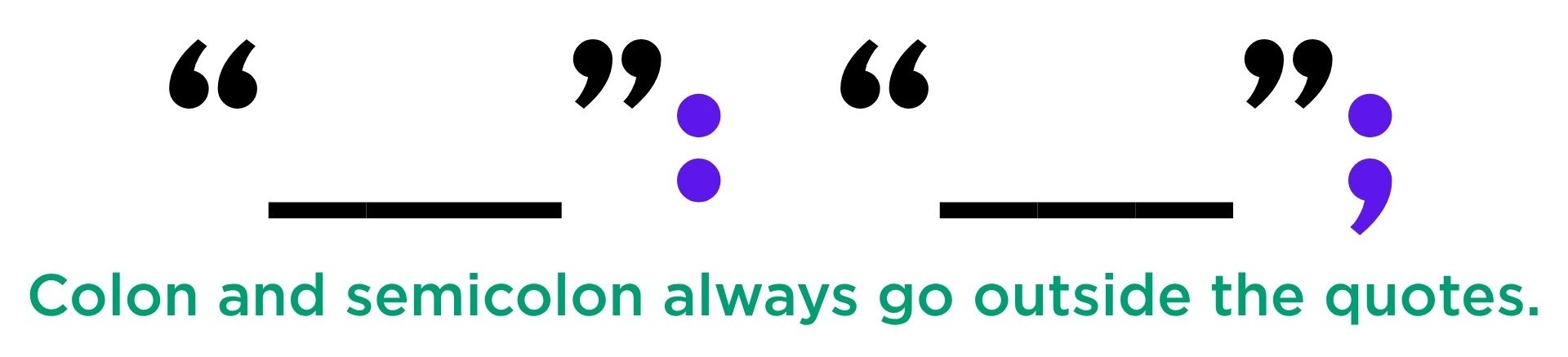
Question mark and exclamation point go either inside or outside the quotes, depending on whether the mark applies to just what’s inside the quotes or to a larger unit:

Ok; that’s it for reviewing punctuation rules. Those are the most important ones. You’ll have to check out a grammar/mechanics handbook if you want to review use of apostrophes, brackets, braces, slashes, periods, and so on.
Lesson 10 Practice: Conquer Punctuation

Enter your revision in the box below each exercise. Click the “>” below each box to see Dr. Hirst’s revision.
- Since this section is long, we’ve provided a link to jump to the practice exercises for colons, semicolons, dashes, and ellipses
Exercise 1: Comma Practice
The eight sentences below may or may not be correct. Punctuate correctly and effectively by adding commas to sentences you believe need to be fixed and write “correct” in the box if no change is needed.
1. After working through the year-end assessment we must meet with the stockholders but that won’t be for three weeks.
> Open to see Dr. Hirst’s sample response.
After working through the year-end assessment, we must meet with the stockholders, but that won’t be for three weeks.
2. Our security guards are ever watchful and alert and ready for anything.
> Open to see Dr. Hirst’s sample response.
Correct as is.
3. The meeting sped along with scintillating reports and analyses and presentations and discussions and motivational messages from the president and all five vice presidents and every departmental head.
> Open to see Dr. Hirst’s sample response.
Correct as is.
4. Our hydrology group monitors area G which has been radionuclide free. [non-restrictive]
> Open to see Dr. Hirst’s sample response.
Our hydrology group monitors area G, which has been radionuclide free.
5. The weir control that was designed for low flow has been repaired. [restrictive]
> Open to see Dr. Hirst’s sample response.
Correct as is.
6. The weir control which was designed for low flow has been repaired. [non-restrictive]
> Open to see Dr. Hirst’s sample response.
The weir control, which was designed for low flow, has been repaired.
7. To calculate the flux from year to year we need complete, and accurate, data.
> Open to see Dr. Hirst’s sample response.
To calculate the flux from year to year, we need complete and accurate data.
8. The supervisor could not make up his mind nor could he for that matter make up an excuse.
> Open to see Dr. Hirst’s sample response.
The supervisor could not make up his mind, nor could he, for that matter, make up an excuse.
For sentences 9-13, use commas rhetorically by following the directions after the sentence.
9. Aside from last week’s minor, radiation accident, we have had no trouble in the plant, or throughout the entire, International sweep, of installations. (Punctuate to speed up)
> Open to see Dr. Hirst’s sample response.
Aside from last week’s minor radiation accident we have had no trouble in the plant or throughout the entire International sweep of installations.
10. Staff members in ERP and ESD have helped identify existing monitoring stations on the island but have not selected sites for the new stations nor helped visiting researchers from our sister lab in the Netherlands to assemble and place their equipment. (Punctuate to slow down a little: allow reader some “breathing space” in which to absorb ideas)
> Open to see Dr. Hirst’s sample response.
Staff members in ERP and ESD have helped identify existing monitoring stations on the island, but have not selected sites for the new stations nor helped visiting researchers, from our sister lab in the Netherlands, to assemble and place their equipment.
11. The meeting dragged on with reports and analyses and presentations and discussions and motivational messages from the president and from each of the vice presidents and from every departmental head. (Punctuate to slow down a lot: increase the sense of “dragging”)
> Open to see Dr. Hirst’s sample response.
The meeting dragged on with reports, and analyses, and presentations, and discussions, and motivational messages from the president, and from each of the vice presidents, and from every departmental head.
12. First-aid boxes—located as usual to the left of welding stations—must be restocked regularly. (Punctuate to achieve medium emphasis)
> Open to see Dr. Hirst’s sample response.
First-aid boxes, located as usual to the left of welding stations, must be restocked regularly.
13. It was the best time to invest it was the worst time to invest. (Punctuate to display balance)
> Open to see Dr. Hirst’s sample response.
It was the best time to invest, it was the worst time to invest.
Note: occasionally you might actually intend a comma splice. Consider the case above. The comma links short, balanced, independent clauses (“isocolonic” sentences), emphasizing something about the pairing. The thought-provoking irony of two seemingly contradictory ideas coupled within the same truth-pod? I caution you against overusing this move, but you can do it now and then if you’re skilled. Think Charles Dickens.
Exercise 2: Colons, Semicolons, Dashes and Ellipses
Supply the missing colons, semicolons, dashes, and ellipses; remove the unnecessary ones. Substitute colons, semicolons, dashes, and ellipses for other pieces of punctuation where doing so seems to improve the sentence:
1. This hydrograph shows a similar trend a general decline in precipitation.
> Open to see Dr. Hirst’s sample response.
This hydrograph shows a similar trend: a general decline in precipitation.
2. The opportunity opening up in Russia, potentially worth over a billion dollars to our company will not stay open long.
> Open to see Dr. Hirst’s sample response.
The opportunity opening up in Russia—potentially worth over a billion dollars to our company—will not stay open long.
3. The bank clerk finally returned, carrying the safe deposit box, he opened it and we saw to our amazement that it contained nothing.
> Open to see Dr. Hirst’s sample response.
The bank clerk finally returned, carrying the safe deposit box; he opened it and we saw to our amazement that it contained . . . nothing.
Of course you could have used a dash instead of an ellipsis, but the dramatic pause would then be a bit shorter. Or if you wanted dreadful speed instead of a pause at the end, you could have omitted punctuation of any kind between “contained” and “nothing.”
4. The mounting pressure of the river ice, slowly pushing up a glacier-like mound, the high winds, felling telephone poles and huge, ice-coated trees, the alternate snow and freezing rain (cutting down visibility to nearly zero) it was an onslaught of nature for which they were not prepared.
> Open to see Dr. Hirst’s sample response.
The mounting pressure of the river ice, slowly raising up a glacier-like mound; the high winds, felling telephone poles and huge, ice-coated trees; the alternate snow and freezing rain, cutting down visibility to nearly zero—it was an onslaught of nature for which they were not prepared.
The mounting pressure of the river ice, slowly raising up a glacier-like mound; the high winds, felling telephone poles and huge, ice-coated trees; the alternate snow and freezing rain, cutting down visibility to nearly zero—it was an onslaught of nature for which they were not prepared.
5. Two countries have agreed to grant us permits; Mexico and Colombia.
> Open to see Dr. Hirst’s sample response.
Two countries have agreed to grant us permits: Mexico and Colombia.
6. The two countries that have agreed to grant us permits, Mexico with its rampant crime and corruption and Colombia with its gangs and terrorists completely out of control are actually the countries hosting the best flora and fauna for our research.
> Open to see Dr. Hirst’s sample response.
The two countries that have agreed to grant us permits—Mexico, with its rampant crime and corruption, and Colombia, with its gangs and terrorists completely out of control—are actually the countries hosting the best flora and fauna for our research.
7. After much hesitation, that is, after seeming to hesitate much, they delivered their verdict, guilty.
> Open to see Dr. Hirst’s sample response.
After much hesitation . . . that is, after seeming to hesitate much . . . they delivered their verdict: guilty.
Again, dashes could replace the ellipses, but the timing, and therefore the stylistic effect, would then be a bit different.The two countries that have agreed to grant us permits—Mexico, with its rampant crime and corruption, and Colombia, with its gangs and terrorists completely out of control—are actually the countries hosting the best flora and fauna for our research.
Let’s do one final exercise: improving a couple paragraphs that need more effective punctuation. Use the Print Code to separate or join textual elements; to create or reinforce relationships; to reveal structure; to extend or insert elements; to eliminate ambiguity; to speed up or slow down; to emphasize or de-emphasize. Be sure to remove punctuation that seems inappropriate.
Exercise 3: Final Challenge
Revise the following paragraphs to improve style. Make no changes except in punctuation.
The proposed Energy Recovery Facilities, burn dumps, have been dumped on by Greenpeace, and the Audubon Society, and Citizens for a Cleaner Tennessee, and a truckload of other organizations, yet the fact remains that this proposal is the best one, to come before our legislature. All the other proposals seem based on three premises; that New York has a bottomless treasury, that we are more afraid of air pollution than of land or water pollution, and that most of us are perfectly willing to expand, or to increase the number of, our existing landfills.
But the proposal we’re now considering describes a way to dispose of our state’s waste which is currently straining our landfills to their limits within budget and without expanding the landfills; expanding the landfills would present its own legal dilemma by the way. It projects the impact on air quality in layman’s terms and a good thing, since none of us here are scientists: and it goes on to project the overall minimal impact on animal life in the state with special attention to the species we most value; humans. Finally it crunches heaps of numbers and demonstrates how the proposed facilities will, in time, become economically self supporting. These Energy Recovery Facilities will in short take care of the landfill crisis which is our most immediate problem, they will work within our current budget, which is an absolute necessity and they will eventually prove to be a positive boon to our area’s economy and to our prospects for reelection.
> Open to see Dr. Hirst’s sample response.
The proposed Energy Recovery Facilities (burn dumps) have been “dumped on” by Greenpeace and the Audubon Society and Citizens for a Cleaner Tennessee and a truckload of other organizations-yet the fact remains that this proposal is the best one to come before our legislature. All the other proposals seem based on three premises: that New York has a bottomless treasury; that we are more afraid of air pollution than of land or water pollution; and that most of us are perfectly willing to expand, or to increase the number of, our existing landfills.
But the proposal we’re now considering describes a way to dispose of our state’s waste—which is currently straining our landfills to their limits—within budget and without expanding the landfills (expanding the landfills would present its own legal dilemma, by the way). It projects the impact on air quality in layman’s terms—and a good thing, since none of us here are scientists—and it goes on to project the overall (minimal) impact on animal life in the state, with special attention to the species we most value: humans. Finally, it crunches heaps of numbers and demonstrates how the proposed facilities will in time become economically self-supporting. These Energy Recovery Facilities will, in short, take care of the landfill crisis, which is our most immediate problem; they will work within our current budget, which is an absolute necessity; and they will eventually prove to be a positive boon to our area’s economy . . . and to our prospects for re-election.
Congratulations; you’re on your way to becoming a master punctuator!
Return to Professional Writing Style: 12 Tutorials main page